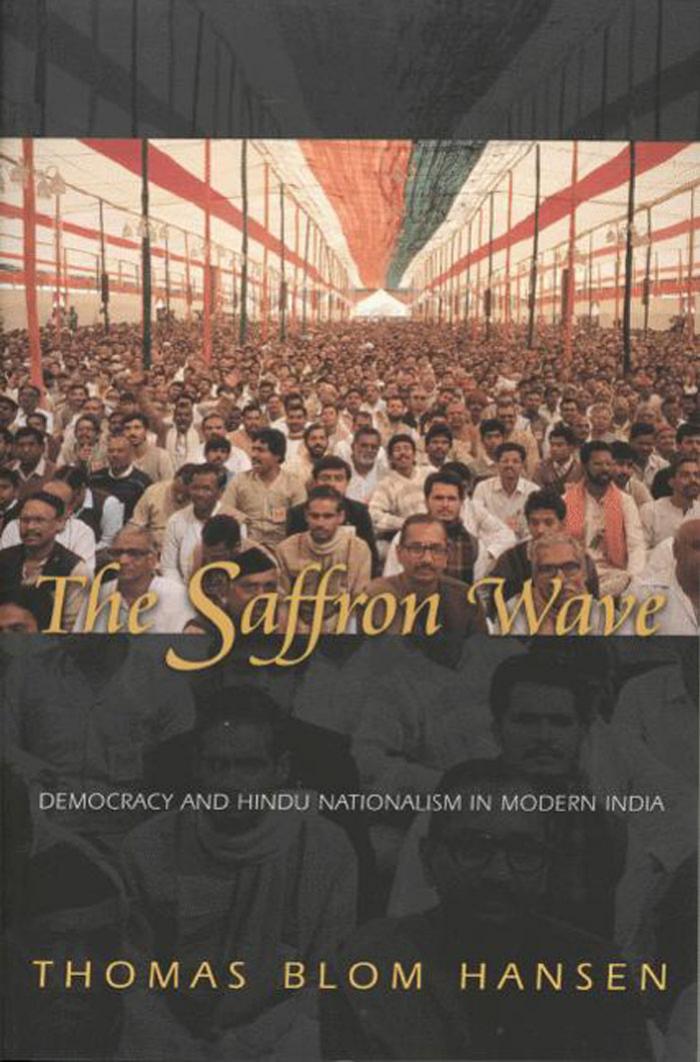
The Saffron Wave: Democracy and Hindu Nationalism in Modern India by Thomas Blom Hansen
Author:Thomas Blom Hansen [Thomas Blom Hansen]
Language: eng
Format: epub, pdf
Published: 2010-08-11T17:19:00+00:00
To most of the families I met and interviewed in Pune, the political imaginaries and the imagination of the mechanisms of the political field were marked by deep ambivalences. On the one hand, politics was seen as corrupt and politicians generally denounced as dishonest and semi-criminal. The political field was depicted as an area marked by erosion of moral principles and proper behavior in favor of commercialized and criminalized behavior. In this upper-caste environment, the "decay" of the world of politics was unequivocally ascribed to the rising assertiveness of lower-caste politiciansdepicted as "goonda types" or "uncultured types." Similarly, the ostensible decline in the quality of public administration was attributed to the influx of ever more officers from the lower castes.
Almost all the families denied that caste was an active factor in the community. The official discourse of caste as a thing of the past has become integrated into everyday language, not least in upper-caste educated families. But other discourses on caste did frequently break through these narratives, as remarks in passing on the essential character of certain other caste groups, on cleanliness, on the "atmosphere" of an area, and so on. The parameters of caste were in a sense extended and transformed into an idiom of civic conduct and order: private purity was extended into public hygiene; brahminical values into societal discipline, education, and culture; the notion of a brahmin caste spirit into "modern mentality"; and erosion of caste boundaries became translated into erosion of morality and civic sense, wherein pollution became disorder (dangerous to women), noise, and dirt in public places.
These changes seem to me to constitute genuine transformations, and not mere translations of perennial hierarchies into the idioms of urban modernity. One might say that the conceptual grammar of caste seems to continue as the reproduction of logics of differentiation and hierarchical separation (see also Gupta 1991). The political organization of caste obviously contributes in numerous ways to the consolidation and simplification of castes into states of "sociological solidity." Confronted with the problematics of urban modernity, a competitive labor market, competitive electoral mobilization, the alphabet-or signification-of caste is constantly sliding. The meanings of certain practices, boundaries, and caste myths have within the last few decades increasingly become inscribed into changing surfaces of democratic competition between groups and communities, and of competitive access to jobs, business, and education. As the signification of caste has changed, the signified-the hierarchy of differences-has also been transformed and extended from ritual purity toward civic conduct, Oxford degrees, or NRI (nonresident Indian) status. It seems, nonetheless, that important dimensions of the conceptual grammar of caste-separation and hierarchy-tend to be reproduced again and again.
To the middle-class professionals living in Pune and aspiring to become as "modern" as those in the Camp area, caste identities appear obsolete in their older forms. Instead this logic of discreteness and hierarchization is reproduced in notions of the advanced stage of their own sophistication (as modern liberals) and as the natural physical and cultural distance of their community from other, less advanced groups.
Download
The Saffron Wave: Democracy and Hindu Nationalism in Modern India by Thomas Blom Hansen.pdf
This site does not store any files on its server. We only index and link to content provided by other sites. Please contact the content providers to delete copyright contents if any and email us, we'll remove relevant links or contents immediately.
| Anthropology | Archaeology |
| Philosophy | Politics & Government |
| Social Sciences | Sociology |
| Women's Studies |
The Secret History by Donna Tartt(19105)
The Social Justice Warrior Handbook by Lisa De Pasquale(12197)
Thirteen Reasons Why by Jay Asher(8921)
This Is How You Lose Her by Junot Diaz(6894)
Weapons of Math Destruction by Cathy O'Neil(6285)
Zero to One by Peter Thiel(5808)
Beartown by Fredrik Backman(5769)
The Myth of the Strong Leader by Archie Brown(5513)
The Fire Next Time by James Baldwin(5454)
How Democracies Die by Steven Levitsky & Daniel Ziblatt(5225)
Promise Me, Dad by Joe Biden(5157)
Stone's Rules by Roger Stone(5091)
A Higher Loyalty: Truth, Lies, and Leadership by James Comey(4967)
100 Deadly Skills by Clint Emerson(4932)
Rise and Kill First by Ronen Bergman(4797)
Secrecy World by Jake Bernstein(4756)
The David Icke Guide to the Global Conspiracy (and how to end it) by David Icke(4724)
The Farm by Tom Rob Smith(4517)
The Doomsday Machine by Daniel Ellsberg(4493)
